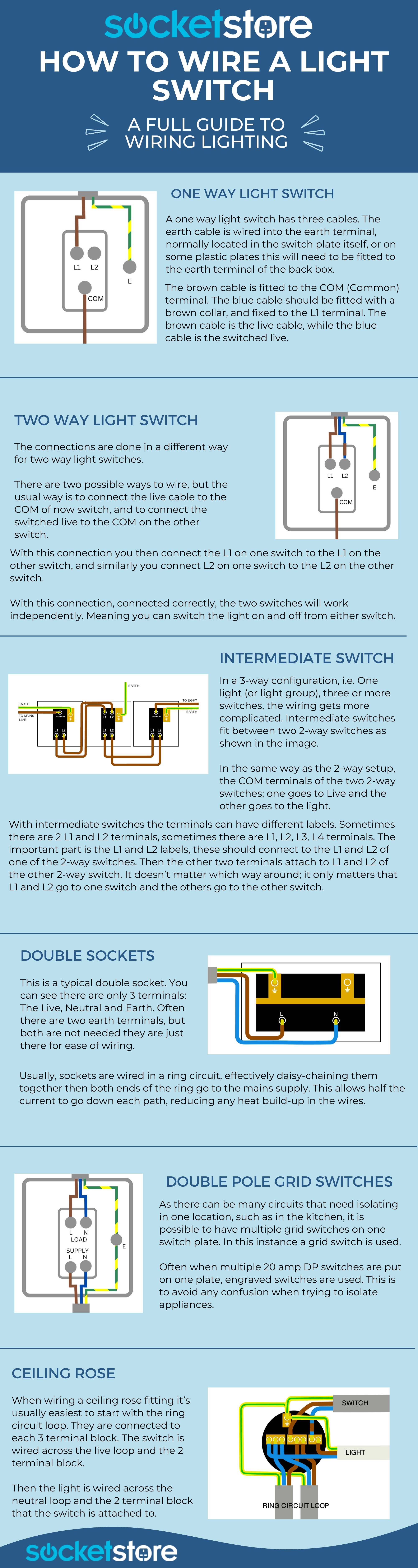
The Complete Wiring Guide
This guide covers the wiring principles behind one-way, two-way, and intermediate light switches, double sockets, double pole grid switches, and ceiling roses. It's intended as a reference to help you understand how your electrics are configured — always use a qualified electrician for any actual wiring work.
All the switch types covered here — one-way, two-way, intermediate, double pole and grid — are available across our full range of sockets and switches, in matching finishes from antique brass to matt black.
One Way Light Switch
A one way light switch has three cables. The earth cable is wired into the earth terminal, normally located in the switch plate itself, or on some plastic plates this will need to be fitted to the earth terminal of the back box.
The brown cable is fitted to the COM (Common) terminal. The blue cable should be fitted with a brown collar, and fixed to the L1 terminal. The brown cable is the live cable, while the blue cable is the switched live.
Two Way Light Switch
The connections are done in a different way for two way light switches.
There are two possible ways to wire, but the usual way is to connect the live cable to the COM of one switch, and to connect the switched live to the COM on the other switch.
With this connection you then connect the L1 on one switch to the L1 on the other switch, and similarly you connect L2 on one switch to L2 on the other switch.
With this connection, connected correctly, the two switches will work independently. This means you can switch the light on and off from either switch.
Intermediate Switch
In a 3-way configuration — one light (or light group), three or more switches — the wiring gets more complicated. Intermediate switches fit between two 2-way switches.
In the same way as the 2-way setup, the COM terminals of the two 2-way switches: one goes to Live and the other goes to the light.
With intermediate switches the terminals can have different labels. Sometimes there are 2 L1 and L2 terminals, sometimes there are L1, L2, L3, L4 terminals. The important part is the L1 and L2 labels — these should connect to the L1 and L2 of one of the 2-way switches. Then the other two terminals attach to L1 and L2 of the other 2-way switch. It doesn't matter which way around; it only matters that L1 and L2 go to one switch and the others go to the other switch.
For a staircase with a landing, this is the setup you'd typically need — a 2-way switch at the bottom, an intermediate switch on the landing, and a 2-way switch at the top. See our hallway sockets and switches guide for more on this in practice.
Double Sockets
A typical double socket has only 3 terminals: Live, Neutral, and Earth. Often there are two earth terminals, but both are not needed — they're there for ease of wiring.
Usually, sockets are wired in a ring circuit, effectively daisy-chaining them together, with both ends of the ring going to the mains supply. This allows half the current to go down each path, reducing any heat build-up in the wires.
Double Pole Grid Switches
Where there are many circuits that need isolating in one location, such as in a kitchen, it's possible to have multiple grid switches on one switch plate. In this instance a grid switch is used.
Often when multiple 20 amp double pole switches are put on one plate, engraved switches are used, to avoid any confusion when trying to isolate appliances. See our double pole switch guide for more on how these work.
Ceiling Rose
When wiring a ceiling rose fitting, it's usually easiest to start with the ring circuit loop. These are connected to each 3 terminal block. The switch is wired across the live loop and the 2 terminal block.
Then the light is wired across the neutral loop and the 2 terminal block that the switch is attached to.
Always use a qualified electrician
This guide is intended to help you understand the principles behind common wiring configurations, not as a substitute for a qualified electrician. Incorrect wiring is dangerous. Always have any electrical work carried out or checked by a qualified, registered electrician.
Frequently Asked Questions
What's the difference between a one-way and a two-way light switch?
A one-way switch controls a light from a single location. A two-way switch allows a light to be controlled from two different locations, using L1 and L2 terminals to connect the two switches together.
When do I need an intermediate switch?
An intermediate switch is needed when a light is controlled from three or more locations — for example, a staircase with a landing. It fits between two 2-way switches.
How is a double socket wired?
A double socket has three terminals — live, neutral, and earth — and is usually wired as part of a ring circuit, where both ends of the ring connect back to the mains supply.
What is a double pole grid switch used for?
A double pole grid switch allows multiple circuits to be isolated from a single plate, commonly used in kitchens where several appliances need dedicated isolation switches.
Related guides: what size back box do I need?, what is a double pole switch?, and hallway sockets and switches.