

Victorian Switches and Sockets: A Style Guide
What are Victorian-style switches and sockets?
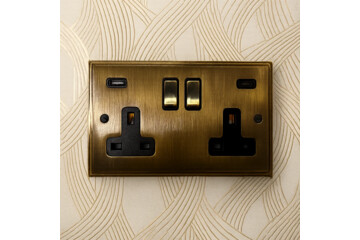
Victorian-style switches and sockets take their design cues from the decorative metalwork of the Victorian era (1837–1901). They are characterised by plates with a stepped edge profile and traditional toggle switches — a deliberate contrast to the flat, minimalist aesthetic of modern wiring accessories.
At Socket Store, the Victorian aesthetic is available in two distinct plate constructions: Victorian (pressed brass) and Victorian Cast (cast brass). Both share the stepped edge profile associated with the period, but differ in manufacturing process, weight, and the precision of the edge detail.
Victorian vs Victorian Cast: what's the difference?
Victorian
Pressed brass plates with a stepped edge profile. Pressing is the standard manufacturing method for metal switch plates — the brass is formed under pressure into shape. The result is a well-made, traditional plate with clear period character.
Victorian Cast
Cast brass plates, also with a stepped edge profile, but produced by pouring molten brass into a mould. The casting process produces a heavier, more substantial plate, and the stepped edge is sharper and more precisely defined than on a pressed plate. Victorian Cast plates have a more solid feel in the hand and a crisper visual profile on the wall.
If you want a traditional Victorian aesthetic at a more accessible price point, the pressed Victorian range delivers it well. If you want maximum weight, presence, and edge definition, Victorian Cast is the premium choice.
What makes a switch Victorian in style?
Three elements define the Victorian look:
The plate — A stepped edge profile, heavier construction, and ornate character distinguish Victorian-style plates from flat or bevelled contemporary alternatives.
The rocker or toggle — Victorian-style switches most commonly use a dolly toggle rather than a rocker, which reinforces the period feel.
The finish — Antique brass is the classic choice for Victorian switches, though the style works equally well in bronze, matt black, and aged copper finishes.
Which finishes suit Victorian-style switches?
Antique Brass
The most authentic pairing. Antique brass has a warm, slightly dulled tone that suggests age and quality. Unlike polished brass, it does not require lacquering or maintenance — the finish is stable and will not tarnish further over time.
Bronze
A darker, richer alternative to antique brass. Bronze-finish Victorian switches work particularly well in rooms with dark woodwork, leather furniture, or deep wall colours.
Matt Black
A more contemporary reading of the Victorian style. Matt black Victorian switches have become popular in industrial-influenced interiors and in kitchens where the period detailing provides contrast against modern cabinetry.
Aged Copper
Warmer than bronze, softer than antique brass. Aged copper Victorian switches suit arts-and-crafts interiors and rooms with terracotta, rust, or warm neutral tones.
What rooms suit Victorian switches?
Living rooms and sitting rooms — The most common application. Victorian switches complement fireplaces, cornicing, picture rails, and traditional flooring.
Hallways — High-visibility areas where a decorative switch plate makes an immediate impression. Antique brass or bronze works well against dark painted walls or original tiling.
Kitchens — Victorian switches pair naturally with shaker-style cabinetry. Matt black is a popular finish here. Note that 20-amp double pole switches in a matching Victorian finish are available for isolating below-worktop appliances such as dishwashers, washing machines, and ovens.
Bedrooms — The stepped edge profile adds character without overwhelming a restful space. Antique brass and aged copper are the most popular bedroom choices.
Studies and libraries — A natural fit. The period aesthetic reinforces the warmth of wood panelling, bookshelves, and traditional desk lighting.
Victorian, Victorian Cast, and Georgian: what's the difference?
All three are traditional styles, but each has a distinct character.
Victorian — Pressed brass plates with a stepped edge. Traditional period character, well-made, and available across a wide range of finishes.
Victorian Cast — Cast brass plates with a stepped edge. Heavier and more substantial than pressed Victorian plates, with a sharper, more precisely defined edge profile. The premium choice within the Victorian aesthetic.
Georgian — Pressed plates with a rope-edge border rather than a stepped edge. More restrained and formal in character than either Victorian style. Georgian suits listed buildings, formal rooms, and interiors where refinement takes precedence over ornamentation.
Are Victorian-style switches made in Britain?
Yes. Both the Victorian and Victorian Cast ranges are made in Britain and carry a 10-year warranty. All plates are available in a full suite of wiring accessories — singles, doubles, dimmers, USB outlets, TV points, and 20-amp switches — so an entire room can be fitted in a consistent finish.
Frequently asked questions
Can I use Victorian switches in a modern home?
Yes. Victorian-style switches are popular in both period and contemporary properties. In a modern home they add warmth and a focal point of craftsmanship — particularly effective in rooms with neutral walls, natural materials, or a maximalist aesthetic.
Do antique brass Victorian switches need polishing?
No. The antique brass finish on Victorian switches is stable and does not require polishing or maintenance. It will not tarnish further under normal conditions.
What is the difference between antique brass and polished brass?
Polished brass is bright and reflective with a gold-like appearance, and requires lacquering to prevent tarnishing. Antique brass is warmer, softer, and more muted in tone — the more traditional and lower-maintenance choice for period-style interiors.
What is the difference between a toggle switch and a standard switch?
A standard switch uses a rocker mechanism — a flat paddle that rocks forward and back. A toggle switch uses a small lever or dolly that flips up and down. The toggle is the more traditional of the two and is closely associated with Victorian-style wiring accessories.
What is the difference between Victorian and Victorian Cast plates?
Both have a stepped edge profile. Victorian plates are pressed brass — the standard manufacturing method for metal switch plates. Victorian Cast plates are cast brass, which produces a heavier plate with a sharper, more defined edge. Victorian Cast is the more premium option.
Are Victorian toggle switches available as dimmers?
Check individual product listings, as dimmer availability varies by finish and gang configuration.
Can I get a full room set in Victorian antique brass?
Yes. The range covers sockets, switches, dimmers, USB outlets, TV points, data plates, and 20-amp double pole switches, so a full room installation is achievable in a single consistent finish.
Browse the full Victorian antique brass range at Socket Store.